We’re talking about mechanical concrete preparation and grinding. A lot of people ask us, "Can’t you just clean it and pour the coating on top?" To explain why that doesn't work, let’s look at an analogy.
The "Velcro" Principle
Think about trying to join two pieces of fabric together. If you take a piece of
Velcro and try to pressed it against a flat, silky-smooth piece of ribbon, it might stay for a second, but the moment you tug on it or walk on it, it’s going to slide right off. There’s nothing for those tiny hooks to grab onto.
Now, imagine pressing that same Velcro against a piece of fuzzy wool. Those hooks sink in, interlock, and become nearly impossible to pull apart without a fight.
Concrete grinding is how we turn your "silky ribbon" floor into "fuzzy wool."
Why Grinding is Non-Negotiable
Standard concrete—especially if it’s old—is covered in what we call
Laitance. This is a weak, milky layer of cement dust and lime that rises to the surface as concrete cures. It’s brittle and thin. If we coat over that, your floor isn't sticking to the concrete; it’s sticking to the dust.
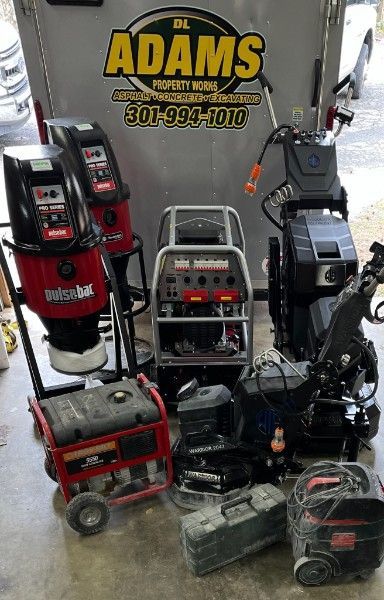
When we use our
industrial diamond grinders, we are doing two vital things:
- Opening the Pores: Concrete is naturally porous, like a sponge. Over time, those pores get clogged with oils, old sealers, and dirt. Grinding "opens the mouth" of the concrete so the new resin can actually soak in and root itself deep into the slab.
- Creating the "Profile": Just like the Velcro analogy, the grinder creates a microscopic texture (sandpaper-like) that gives the coating a physical "grip." Without this "mechanical bond," the coating is just sitting on top.
What Happens Without Proper Prep?
If a contractor skips the grinding and just "acid washes" or mops the floor before resurfacing, you might be happy for a month. But soon, you’ll see:
- Hot Tire Pick-up: The heat from your car tires will literally peel the coating off the floor like a scab.
- Flaking and Bubbling: Moisture trapped under the surface will push the "un-anchored" coating up.
- Cracking: Because the coating isn't "one" with the concrete, it can't handle the natural expansion and contraction of the slab.
The Adams Property Works Standard
At Adams Property Works, we don’t just "paint" floors. We engineer them.
Our process involves heavy-duty planetary grinders that leveled out imperfections and vacuum systems that keep your home dust-free. We grind until we reach "white concrete"—the pure, strong heart of the slab. Only then do we apply the resurfacer.
When we’re done, your new floor isn't just on the concrete; it is
part of the concrete.
Is your garage or basement floor ready for a permanent upgrade?
Click here to schedule a free estimate and let’s talk about how we can prep your property for a lifetime of durability.